Does speed reading work? Reading speed vs comprehension
Speed reading involves a tradeoff. Learn what the Rayner review says, when to skim, and how to check understanding before chasing a faster pace.
Speed reading trades comprehension for pace, according to Keith Rayner, Elizabeth Schotter, Michael Masson, Mary Potter, and Rebecca Treiman's 2016 review, So Much to Read, So Little Time, in Psychological Science in the Public Interest. Skimming can provide a broad understanding while sacrificing detail. Rayner et al., 2016.
For a practical response, choose the reading task before choosing a pace. Skim to decide whether a text deserves attention; read closely when you need to explain its reasoning. Then check whether you can do what you intended. Use words per minute as a description of that session, without making it the sole target.
Put the normal reading range in context
Rayner and colleagues report about 200–400 words per minute for skilled, college-educated adults. 200–300 wpm falls within that range; it isn't the paper's full interval. Reading rates also vary with the reader and text. Rayner et al., 2016.
Use the range for context, rather than grading your performance against it. If you're studying an unfamiliar argument, count the session as study, including pauses for notes and definitions. If you're browsing a familiar topic, label the activity accordingly. Keep those purposes visible whenever you compare your own reading sessions.
Before using a reading-rate result, ask how it was calculated. Does the clock include checking a term, returning to a paragraph, or writing a note? Were you asked to explain the text afterward? Record those conditions alongside any rate you measure. Treat a faster result as something to examine against your task.
Read the tradeoff as a relationship, not a cutoff
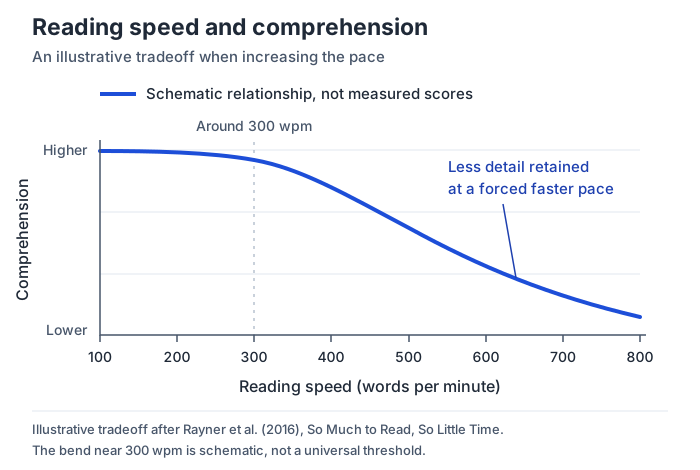
The line is a visual explanation of the tradeoff discussed by Rayner and colleagues, not a fitted curve from their data. Its vertical scale has no comprehension percentages. The bend near 300 wpm is a drawing choice, so don't use it to predict a score or identify your personal limit.
Imagine reading a hypothetical proposal for a neighborhood garden. If you only need to decide whether to attend its planning meeting, aim to identify the proposal, location, and unresolved issues. If you need to assess its budget, read the assumptions and calculations closely enough to explain them. Judge each session against the task you chose.
Examine what a speed-reading technique asks you to change
Rayner and colleagues emphasize language processing and useful rereading, challenging accounts that reduce reading to eye movement. They also examine rapid serial visual presentation, which displays words in sequence, and its limits for comprehension. Rayner et al., 2016.
When assessing a technique, write down its instructions in plain terms. Perhaps it asks you to follow a pointer, avoid returning to earlier words, or accept a fixed display speed. Then identify which part you want to test. Change that part deliberately instead of combining several techniques and judging the entire package by how fast it feels.
Check the advertised outcome with the same care. If a demonstration asks only for the topic, don't treat it as a demonstration of detailed understanding. Look for an explanation of the text used, the reader's familiarity with it, the task afterward, and the handling of wrong answers. Require those details before accepting a performance claim.
Match your pace to a specific purpose
Try the following task choices when planning a session. These are suggested ways to organize your reading, rather than experimentally validated categories or speed targets.
| Purpose | Approach to try | What to check afterward |
|---|---|---|
| Select material | Survey headings and sample relevant passages | Explain why the text belongs on your reading list |
| Follow an explanation | Read continuously, returning where needed | State the claim and how the author supports it |
| Study an argument | Pause for definitions, notes, and recall | Reconstruct the reasoning and identify an unresolved step |
Write your chosen outcome before opening the text. For example, “I want to explain why the author rejects the first option.” After reading, attempt that explanation without looking. Reopen the relevant pages and check whether your account preserves the author's reasoning and qualifications.
If your purpose changes midway, change your approach. You might survey a chapter, identify an argument you need, and then give that section closer attention. Record the passage for another session if you lack time to examine it now. Avoid treating the original pace as a commitment you must maintain.
Make your own reading check useful
For a personal trial, choose unfamiliar passages on a similar subject and define the same task for each. Read one at your usual pace and another with the proposed technique. Record the time, but also write down what you think each passage says before looking back at it.
Check the main claim, its supporting evidence, and any qualification you would need to include when explaining it to someone else. For the hypothetical garden proposal, examine whether you distinguished a confirmed cost from an estimate. Mark each correction visibly so your final polished note doesn't hide what you initially missed.
Treat this as feedback for your reading choices, not a controlled experiment. Use your notes to decide which passages deserve another attempt. Avoid drawing a universal conclusion about a technique from a single personal trial.
If your explanation leaves out a key step, slow down for that passage and examine it again. If you can complete your intended task, decide whether more detail would serve another purpose. Keep the judgment tied to the text and your reasons for reading it.
At your next reading session, write one thing you want to explain afterward, then choose a pace that lets you attempt that explanation.