How to read difficult books without losing the thread

Preview the structure, work through the argument, and test what you can recall. A practical approach grounded in Adler, SQ3R, and memory research.
To read a difficult book, begin by surveying its structure, choose a question to follow, then read a manageable section and explain it with the book closed. Use your explanation to decide what needs another pass. This routine combines Mortimer Adler and Charles Van Doren's reading levels in How to Read a Book (1972) with Francis Robinson's SQ3R method in Effective Study (first published 1941).
For your next reading session, aim to produce a short account of the author's claim, its supporting evidence, and one unresolved point. Treat that as a working note, open to correction. The steps below are a suggested way to put those methods into practice, with recall checks informed by Henry Roediger and Jeffrey Karpicke's 2006 research.
Choose the level of reading your task needs
Adler and Van Doren distinguish four levels: elementary, inspectional, analytical, and syntopical. Inspectional reading surveys a book within limited time; analytical reading examines its meaning and argument more fully. Their framework also includes reading across books around a shared problem. The table pairs those levels with suggested notebook tasks. Adler and Van Doren, How to Read a Book, 1972.
| Reading level | Main purpose | A task to try |
|---|---|---|
| Elementary | Understand the words and sentences | Paraphrase an unfamiliar sentence |
| Inspectional | Identify the subject and structure | Sketch a map from the contents and selected passages |
| Analytical | Examine the argument in one work | Connect a claim to its reasons and assumptions |
| Syntopical | Compare works on a common question | Set different authors' answers beside each other |
Choose a level according to what you need from the book today. If you're deciding whether it belongs in an essay bibliography, start with inspection. If you need to challenge its central argument, plan an analytical pass. Don't require yourself to complete every task in the table during every session.
Preview the structure before committing to details
For an inspectional pass, Adler and Van Doren recommend examining the title, preface, contents, and index, then sampling significant parts of the book. They also advise a first reading that moves through difficulties without stopping to settle every one. Adler and Van Doren, 1972.
Try making a rough map on a blank page. Write the book's apparent subject at the top, then group its chapters under a few headings of your own. Beside each group, note what you expect it to explain. Use tentative language such as “seems to introduce the problem” until you've read enough to check.
For a novel, adapt the preview to your preferences about spoilers. Look at its divisions and opening pages, then note the narrator, setting, and questions you want to follow. Leave the ending alone if discovering it is part of why you're reading. Use the map to orient your attention without prescribing an interpretation.
Use SQ3R for a section that needs study
Robinson's SQ3R sequence is survey, question, read, recite, review. Northern Arizona University's Academic Success Centers describe the method and cite a later edition of his Effective Study, first published in 1941. Reciting means attempting an answer in your own words after reading. Northern Arizona University, “SQ3R Reading Method,” citing Robinson.
Here is a suggested application to a hypothetical chapter about public transport. The questions and examples are invented for practice, rather than findings about transport policy.
- Survey: Look through the section headings. Suppose one concerns who benefits from a new bus route. Note that topic before reading its details.
- Question: Write, “How does the author decide who benefits?” Leave room beneath it for an answer and a passage reference.
- Read: Follow the explanation. Mark where the author defines a benefit and where they supply evidence for it.
- Recite: Close the book and answer your question. Try to distinguish the author's definition from an example used to illustrate it.
- Review: Reopen the section, correct your answer, and return to the question during a later session.
If you can't answer, narrow the task. Try explaining the definition alone, or identify which pronoun refers to which group. Ask for help with that specific obstacle if needed. Return to the larger question after you've worked through the sentence that stopped you.
Examine the reasoning before writing your verdict
Adler and Van Doren's analytical reading asks readers to identify key terms, propositions, and arguments before judging a work. Use that order as a rule for your notebook. Adler and Van Doren, 1972.
In the hypothetical transport chapter, imagine an author arguing that longer opening hours would improve access to a service. Record the claim separately from any example about a person arriving late. Then look for the step connecting that example to the recommendation. Avoid supplying evidence on the author's behalf.
Write your objection as a precise request: “I need evidence that the proposed hours match the affected group's availability.” Compare it with the surrounding pages before treating it as a gap. If the book answers it later, add that reference beside your original note instead of deleting the question.
Check recall and return after a gap
Roediger and Karpicke's Test-Enhanced Learning (2006) compared restudying prose passages with recalling them. Restudying did better on an immediate test; prior recall produced better retention on delayed tests. That finding supports including retrieval practice, without establishing a universal schedule for reading whole books. Roediger and Karpicke, 2006.
Hermann Ebbinghaus's Memory (1885) studied forgetting using learned syllable lists and measured savings in relearning effort. His results are not percentages of a book that every reader will forget. Ebbinghaus, Memory, chapter VII, 1885.
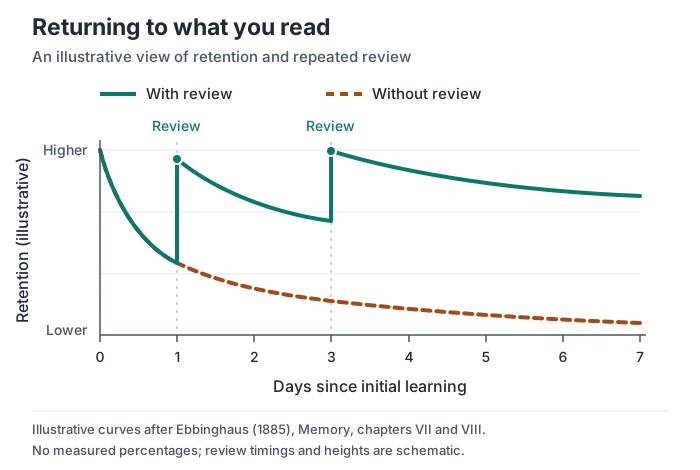
The review line is an explanatory addition, informed by Ebbinghaus's separate discussion of repeated learning in chapter VIII. Neither line predicts your recall or specifies an optimal interval. Use the picture as a reminder to make room for another encounter with the material. Ebbinghaus, Memory, chapter VIII, 1885.
As a starting routine, revisit your question the next day and again later in the week. Attempt an answer before looking at your notes, then correct omissions against the book. Adjust the timing to what you can recall and when you need the material; these intervals are suggestions, not a research prescription.
For your next session, choose one difficult section and leave yourself a single question to answer with the book closed.